

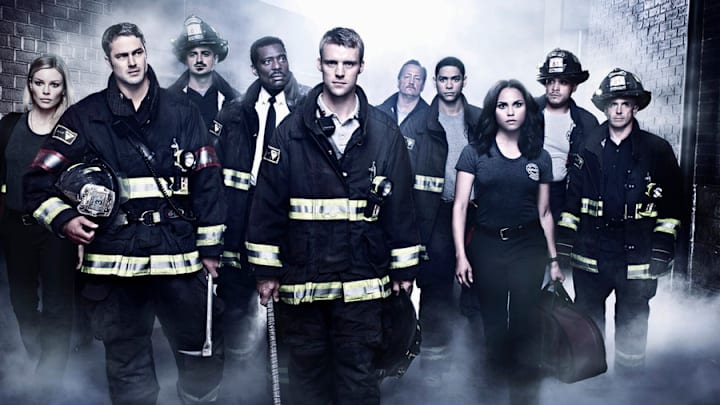
Since the very beginning, crossovers have been a key part of the DNA of NBC’s One Chicago franchise. In looking to establish the universe that would become the One Chicago franchise, the creative teams worked hard to craft a world where the characters didn’t just all exist in their own bubbles, but actually coexisted.
Characters from Chicago Fire, Chicago Med, Chicago PD, and yes, even the often forgotten Chicago Justice crossed over naturally into other shows in the franchise via quick cameos. This resulted in the franchise truly feeling like a shared universe in which the characters naturally crossed over as everyday first responders working out of the same city would in the real world.
It didn’t hurt that the franchise also introduced several interconnected characters within the shared universe, establishing strong relationships between characters which spanned from romantic relationships to sibling dynamics. This made those connections even more natural as it wasn’t surprising at all when you’d see a character such as Jay Halstead pop up on Chicago Med for a storyline involving his brother, Dr. Will Halstead. Or when you’d see a character such as Trudy Platt drop by Firehouse 51 to visit her husband Randall “Mouch” McHolland.
Beyond these smaller crossovers, NBC used the interconnected nature of the shows to stage a number of crossover events with the One Chicago three-show crossovers now a near annual event for the franchise – we missed a few years following the 2020 COVID-19 pandemic and the 2023 writers’ and actors’ strikes. Today, these crossovers are among some of the most epic television events of the season with storylines that effortlessly flow from one show into the next during the three-part crossover events and are a regular occurrence to fans. However, that was not the case 10 years ago.
In the early days of the One Chicago franchise, NBC staged many crossover events but it wasn’t until January 2016 that the network pulled off the first-ever three-show crossover between Chicago Fire, Chicago Med, and Chicago PD. And this crossover event looked much different than the crossovers we’ve come to expect in recent years.
The biggest difference was that the crossover did not unfold over the course of one night. See, back in 2016, the One Chicago shows were airing on different nights of the week with Chicago Fire and Chicago Med airing on Tuesday nights and Chicago PD airing on Wednesday nights. Because of this, the three-show crossover began on Tuesday, January 5, 2016 with Chicago Fire and Chicago Med’s portion of the crossover, before the action came to an end the following day on Wednesday, January 6, 2016 with Chicago PD closing out the crossover.
By design, the storyline told across the three shows carried over from one show into the next; however, the crossover nature wasn’t near what it is today. Back then, it almost felt like one show would pass the baton off rather than flow naturally. For example, the action began with Chicago Fire season 4, episode 10, “The Beating Heart,” when Herrmann was stabbed by a young gang member he tried to help. Chicago Med season 1, episode 5, “Malignant,” continued the story, with the doctors at Gaffney working to save Herrmann’s life, before the final baton was passed to Chicago PD as we watched the Intelligence Unit work to bring Herrmann’s assailant in.
While there was a throughline in the three episodes, the overall crossover plot was on the thin side and almost felt like an afterthought. In fact, if you failed to watch one hour of the event, you’d be able to enjoy the episode without feeling lost, that’s how unconnected the overall storylines were in the first crossover.
Although the original three-show crossover event might not have been as well put together as recent crossovers which feel like a three-hour movie with how the storyline organically plays out across the three shows, these new-age crossovers would never be possible if not for those early crossovers including 2016’s first three-show event. It’s actually wild to look back and think of how far the franchise has come over the years, and it goes to show that the One Chicago franchise has only gotten better with time.
A decade ago, we’d never have thought crossovers like the “In the Trenches” crossover or 2026 crossover would be possible. Thankfully, NBC took a chance back then and that gamble has paid off in spades, paving the way to what are now the best crossover TV has to offer!
 Add us as a preferred source on Google